
Tell an edge from a coincidence.
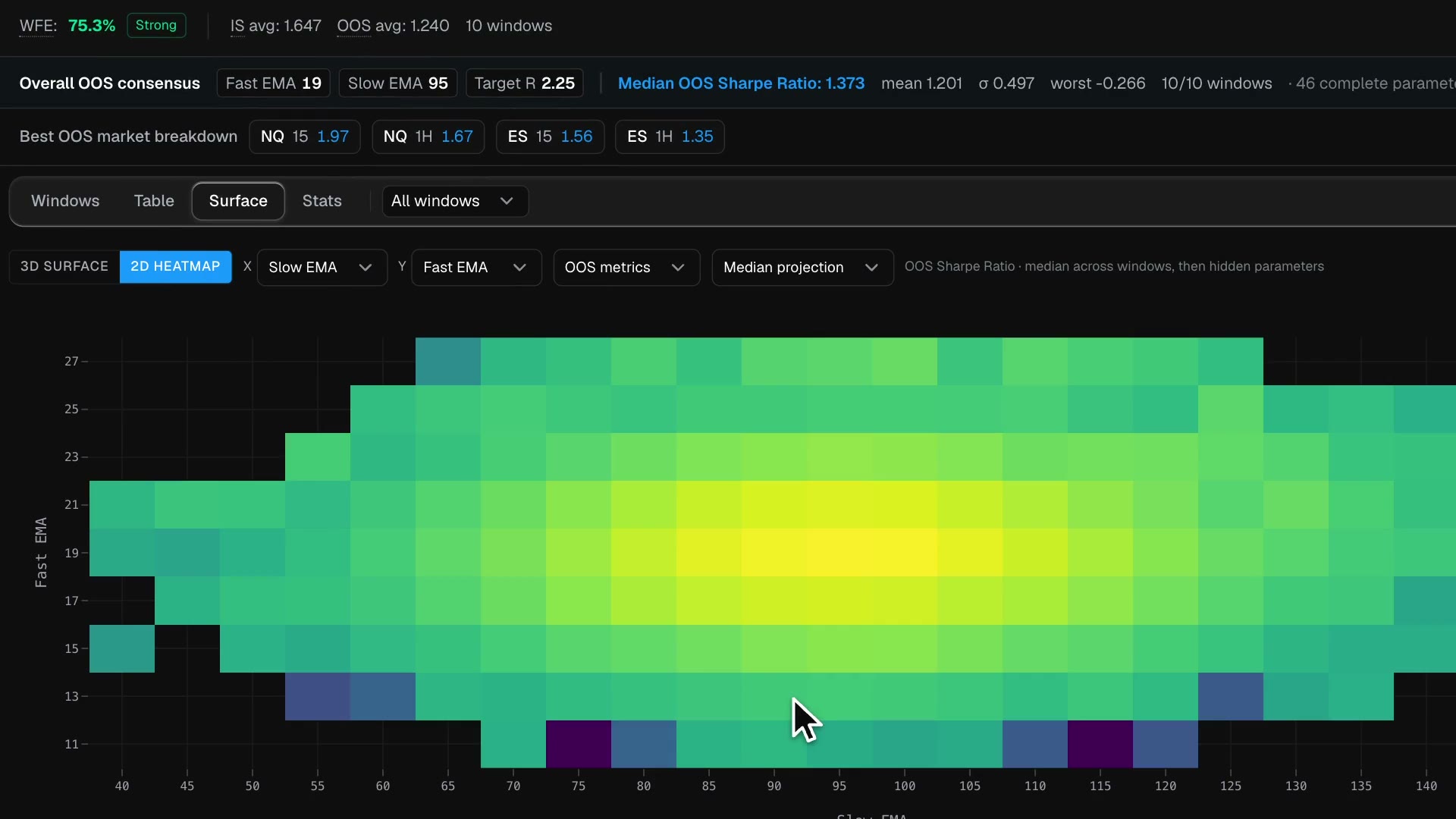
Out-of-sample windows, overfit detection and parameter-stability views help you tell an edge from a coincidence.
How it works
1
Choose a strategy
Pick the strategy you want to tune.
2
Run the sweep
Parameter sweeps run on cloud workers.
3
Read the results
Compare the ranked parameter sets and use the overfit checks.
What you get
Modes by plan
Grid on Pro, more modes on Elite and Ultra. See the table.
Runs in the cloud
Sweeps run on cloud workers.
Overfit checks
Out-of-sample windows, overfit detection and parameter-stability views. Which checks you get depends on your plan.
Bars or ticks
Sweep on bars on every plan. Tick runs start at Pro.
Ranked results
Parameter sets are ranked in a results table.
Same engine
Optimization runs on the same Rust engine as your backtests and live bots.
By plan
| Feature | Free | Charts | Starter | Pro | Elite | Ultra |
|---|---|---|---|---|---|---|
| Optimizer modes | 1 small grid run/day | 1 small grid run/day | 1 small grid run/day | Grid | Grid, Bayesian, genetic, Pareto | All modes + Turbo |
| Maximum trials per job | 15 | 15 | 15 | 500 | 5,000 | 25,000 |
| Parallel optimizer workers | 2 | 2 | 2 | 8 | 16 | 32 + priority |
| Tick optimizer workers | No | No | No | 16 | 32 | 62 |
| Optimizer compute (fair use) | 1 small grid run/day | 1 small grid run/day | 1 small grid run/day | 1,200 vCPU-hours/mo | 1,500 vCPU-hours/mo | 2,000 vCPU-hours/mo |